Top Induction Drive Issues Engineers Should Know
Induction drives play a critical role in modern industrial operations. From manufacturing plants and processing units to HVAC systems and heavy machinery, these drives ensure efficient motor speed control, energy savings, and smooth automation. However, like any industrial equipment, they are prone to technical issues that can disrupt production and increase downtime costs.
Understanding common induction drive issues helps engineers diagnose faults quickly, prevent failures, and plan effective maintenance strategies.
Common Failure Patterns and Root Causes in Induction Drives
Most induction drive problems develop gradually due to electrical stress, thermal overload, environmental exposure, or improper configuration. Rarely does a drive fail without warning. In many cases, early signs such as unusual noise, temperature rise, or minor tripping events indicate deeper internal stress.
Here, we’ll explore the most common induction drive problems, their causes, symptoms, and practical solutions, along with insights into when professional drive repairs become necessary.
1. Overheating of the Induction Drive
Overheating is one of the most common induction drive issues engineers encounter. Industrial environments often expose drives to dust, humidity, and high temperatures. When cooling systems fail, internal components such as IGBTs and capacitors may degrade rapidly. Excessive thermal stress shortens component lifespan and increases the risk of sudden breakdown.
Causes:
- Poor ventilation or blocked cooling fans
- Excessive load on the motor
- High ambient temperature
- Faulty heat sinks
- Dust accumulation inside the drive
Symptoms:
- Frequent drive trips
- Burning smell
- Reduced performance
- Error codes related to temperature
Solution:
- Clean internal components regularly
- Ensure adequate airflow and cooling
- Check load conditions
- Inspect fans and heat sinks
- Replace faulty thermal sensors
If overheating persists, it may require professional drive repair services to inspect damaged internal components and prevent further failure.
2. Voltage Fluctuations and Power Supply Issues
Voltage instability is one of the leading induction drive issues in industrial environments. Induction drives depend on a stable and balanced power supply. Fluctuations can stress internal components, damage rectifiers, and cause DC bus instability, leading to unexpected shutdowns or long-term damage.
Causes:
- Voltage spikes or dips
- Phase imbalance
- Loose or damaged wiring
- Faulty rectifier module
- Poor power quality
Symptoms:
- Drive tripping unexpectedly
- Under-voltage or over-voltage fault codes
- Inconsistent motor speed
- Failure to start
- Blown fuses
Solution:
- Check incoming power supply stability
- Inspect and tighten wiring connections
- Use surge protection devices
- Install voltage stabilizers if required
- Test rectifier and DC bus components
If internal power components are damaged, professional drive repair services are recommended to avoid further complications and ensure safe restoration.
3. IGBT Failure
IGBTs are critical switching components inside an induction drive. They regulate motor speed by controlling output frequency and voltage. When they fail, the drive may completely stop functioning or operate abnormally. IGBT-related induction drive problems often result from thermal stress, overcurrent conditions, or short circuits.
Causes:
- Overcurrent conditions
- Short circuit in motor wiring
- Overheating
- Gate driver circuit failure
- Aging components
Symptoms:
- Drive not powering on
- Output phase imbalance
- Burn marks on PCB
- Repeated fuse blowing
- Motor not running
Solution:
- Check motor insulation and wiring
- Inspect cooling system performance
- Test gate driver circuits
- Replace damaged IGBTs
- Perform output waveform testing
IGBT replacement requires advanced industrial electronics repair expertise to ensure safe and accurate restoration. Improper handling can cause recurring failures.
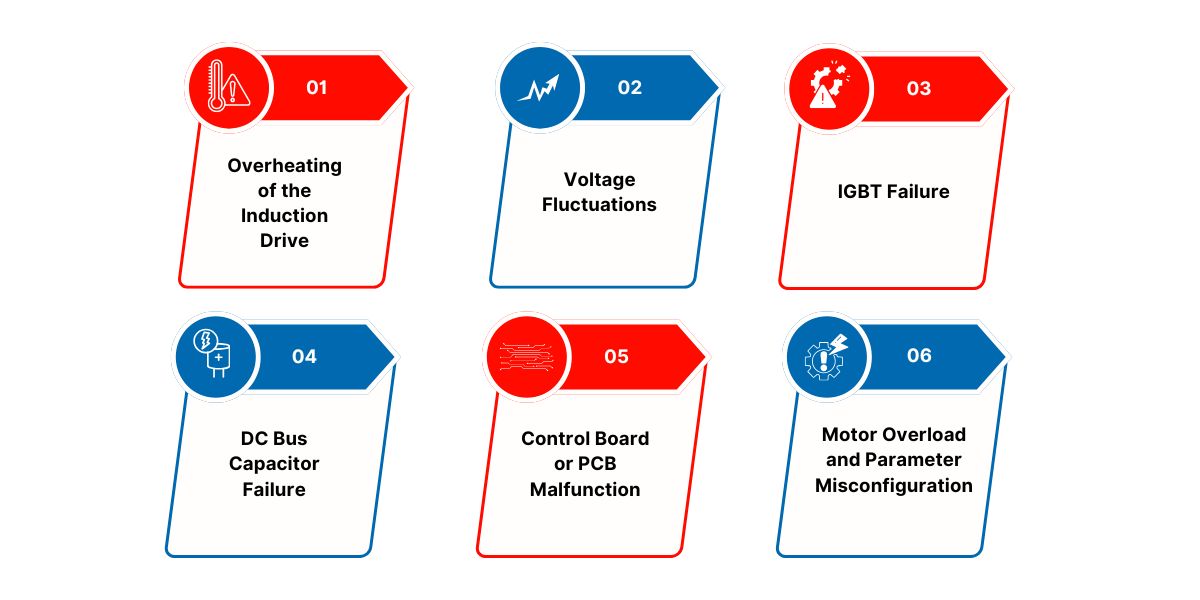
4. DC Bus Capacitor Failure
Capacitors inside the DC bus help stabilize voltage and smooth power supply fluctuations. Over time, they deteriorate due to heat and operational stress, leading to instability and frequent induction drive issues. Capacitor degradation is common in drives that operate continuously under heavy load.
Causes:
- High operating temperatures
- Long-term usage
- Voltage ripple stress
- Poor input power quality
Symptoms:
- Increased ripple voltage
- Drive instability
- Audible humming noise
- Frequent tripping
- Reduced performance
Solution:
- Measure capacitor health and ESR values
- Monitor DC bus voltage levels
- Replace aging capacitors proactively
- Ensure proper cooling
Preventive replacement of capacitors reduces emergency drive repairs and unexpected downtime.
5. Control Board or PCB Malfunction
The control board manages logic processing, communication, and feedback signals. When PCB-related induction drive problems occur, troubleshooting becomes more complex because failures may involve micro-level components.
Causes:
- Moisture exposure
- Dust contamination
- Power surges
- Component burnout
- Loose internal connections
Symptoms:
- Display not functioning
- Communication errors with the PLC
- Random drive shutdowns
- Drive is not responding to commands
Solution:
- Clean the PCB using proper methods
- Inspect for burnt or damaged components
- Test communication ports
- Repair or replace faulty ICs
- Seal control panels against humidity
Complex PCB failures require specialized industrial electronics repair solutions to ensure long-term reliability and precise diagnostics.
6. Motor Overload and Parameter Misconfiguration
Sometimes what appears to be an induction drive issue is actually related to incorrect parameter settings or mechanical overload. Improper configuration can cause repeated tripping and inefficient performance.
Causes:
- Incorrect motor data entry
- Improper acceleration/deceleration settings
- Mechanical load stress
- Bearing or shaft misalignment
Symptoms:
- Frequent overload trips
- Jerky motor operation
- Excessive current draw
- Vibration and noise
Solution:
- Verify motor nameplate data
- Adjust drive parameters properly
- Inspect mechanical alignment
- Monitor current and torque levels
Correct parameter tuning often resolves induction drive problems without requiring major drive repairs.
Preventive Maintenance Strategies to Reduce Induction Drive Issues
Many induction drive problems begin as small performance irregularities, slight overheating, minor voltage imbalance, or intermittent tripping. Early detection and corrective action can prevent these minor issues from developing into major drive repairs.
Key Preventive Maintenance Practices:
- Regular thermal inspection using infrared scanning
- Periodic cleaning to remove dust and debris
- Monitoring input voltage and phase balance
- Checking DC bus voltage stability
- Inspecting cooling fans and ventilation systems
- Tightening electrical connections
- Verifying parameter settings and motor data
Scheduled testing of capacitors, IGBTs, and rectifier modules further ensures that aging components are identified before failure occurs. Implementing a documented maintenance plan allows engineers to track performance trends and predict potential breakdowns.
Partner with the Right Drive Repair Expert for Reliable Industrial Electronics Repair
Industrial operations demand minimal downtime and maximum efficiency. While in-house maintenance teams can handle basic inspections and troubleshooting, complex internal faults require specialized expertise and testing equipment. Choosing an experienced industrial electronics repair service in Dubai ensures accurate diagnosis and reliable repair outcomes.
Professional repair providers conduct detailed testing, component-level analysis, load simulation, and performance verification before returning the drive to operation. Horizon Elect Devices specializes in diagnosing and resolving complex induction drive problems with precision and efficiency. With advanced testing facilities and expertise in industrial electronics repair, their team ensures restored performance, improved reliability, and extended equipment lifespan.